
List of recognized higher education accreditation organizations
This is a list of recognized higher education related accreditation organizations. The list includes agencies and organizations that play a role in higher education accreditation and are recognized by applicable governmental authorities.
International
The International Network for Quality Assurance Agencies in Higher Education (INQAAHE) is a global association of both governmental and non-governmental quality assurance organizations.[1] Its membership list is available online.[2]
The Council for Higher Education Accreditation (CHEA) maintains an international directory of education ministries, as well as assurance and accreditation bodies which have been authorized by their respective governments.[3]
Europe
The European Association for Quality Assurance in Higher Education (ENQA) is responsible for disseminating information, experiences and good practices in higher education quality assurance to quality assurance agencies, public authorities and higher education institutions in the European Higher Education Area (EHEA).[4]
The European Quality Assurance Register for Higher Education (EQAR) is the EHEA's register of quality assurance agencies that comply with the European Standards and Guidelines for Quality Assurance.[5]
The European Network of National Information Centres on academic recognition and mobility (ENIC network) provides information on recognition of foreign qualifications and education systems, opportunities for studying abroad (including information on loans and scholarships), as well as advice on practical questions related to mobility and equivalence.
The National Academic Recognition Information Centre (NARIC) network aims at improving academic recognition of diplomas and periods of study in the EU, the European Economic Area countries, and Turkey. The network is part of the Lifelong Learning Programme (LLP), which stimulates the mobility of students and staff between higher education institutions in these countries. Most NARICs do not take a decision, and instead offer information and advice on foreign education systems and qualifications.
ENIC – NARIC comprises all of Europe, as well as Australia, Canada, Israel, the United States of America and New Zealand, and provides information on the higher education systems and accreditation agencies of the member countries.[6]
Czech Republic
There are public, state and private universities and colleges in the Czech Republic.
Public universities and colleges are established by an act of parliament, and their list is maintained by the Ministry of Education, Youth and Sports.[7] There are two state universities, the University of Defence[8] in Brno and the Police Academy of the Czech Republic [9] in Prague.
Private universities and colleges are established by the private sector. Each of the universities and colleges can only provide higher education on the basis of accreditation issued by the National Accreditation Bureau for Higher Education.[10] There are professional education programs standing outside the higher education system, which are not considered as higher education programs. The providing schools and institutions can be umbrellaed by some private organizations, such as the Czech Association of MBA Schools.[11] The Accreditation, Certification and Member Association of education organization and schools z.s. supervises the quality and regularity of educational institutions.[12][13]
Finland
Universities can only be founded or accredited by an Act of Parliament.[14] Vocational universities are accredited by the Government of Finland, and governed through the Ministry of Education.
Germany
The Standing Conference of the Ministers of Education and Cultural Affairs ensures quality development and continuity in tertiary education.[15] Bachelor and Master programs must be accredited by the Standing Conference.[16]
The German Council of Science and Humanities conducts institutional accreditation of private and religious universities since 2001.[17]
The Foundation for the Accreditation of Study Programs certifies accreditation agencies and establishes guidelines and criteria for program and system accreditation.[18] There are currently ten certified agencies:[19]
- AHPGS – Accreditation Agency for Study Programs in Special Education, Care, Health Sciences and Social Work
- AKAST – Agency for Quality Assurance and Accreditation of Canonical Study Programs
- ACQUIN – Accreditation, Certification and Quality Assurance Institute
- AQAS – Agency for Quality Assurance by Accreditation of Study Programs
- AQ Austria – Agency for Quality Assurance and Accreditation Austria
- ASIIN – Accreditation Agency for Degree Programs in Engineering, Informatics/Computer Science, the Natural Sciences and Mathematics
- evalag – Evaluation Agency Baden-Württemberg
- FIBAA – Foundation for International Business Administration Accreditation
- OAQ – Swiss Center of Accreditation and Quality Assurance in Higher Education
- ZEvA – Central Evaluation- and Accreditation Agency
These agencies accredit programs of study for Bachelor's and Master's degrees and quality management systems (system accreditation) from state or state recognized higher education institutions in Germany and abroad.[20]
Ireland
Quality and Qualifications Ireland was established in 2012 as the single agency responsible for external quality assurance of higher education institutions in Ireland, replacing earlier agencies responsible for different sectors of higher education. It is responsible for the quality assurance of education and research within HEIs. Higher education institutions have been subject to statutory quality assurance since the 1990s and the country has been an active participant in the development of the European model of quality assurance.
Italy
The Italian state controls which institutions can call themselves a University. The Minister of University and Investigation supervises universities.
The system[citation needed] involves two separate but correlated programs:
- Firstly, each university undergoes a four-step process to adopt and approve its own University Academic Regulations. These establish the rules for the organization of teaching at the university, including the requirements and objectives of each degree program, the curricula, credits awarded, and requirements and objectives of examinations. They were developed in consultation with representatives of the individual university, the regional coordinating committee, employers and the National University Council, and are ultimately approved by the (Ministry of Education).
- Secondly, a series of formal objective standards is adopted as minimum requirements for approval of any programs.
Spain
The National Agency for Quality Assessment and Accreditation is the authorized national body responsible for the quality of the Spanish high education system.[21] It was created as a foundation by the Cabinet of Spain under the Organic Law of Universities. Different regional agencies assume the accreditation (and quality levels) of university programs in their respective regions:
- ACPUA, in Aragon
- ACSUCYL, in Castile and Leon
- ACSUG, in Galicia
- AQU, in Catalonia
- AVAP, in Valencian Community
- DEVA-AAC, in Andalusia
- FCM Madrimasd, in Community of Madrid
- Unibasq, in Basque Country
- ACCUEE, in Canary Islands[22]
United Kingdom
Under the Education Reform Act 1988, it is illegal to offer a degree or qualification that implies it is a degree without being authorized by a royal charter or by or under an act of parliament, unless the institution is acting on behalf of an authorized institution or the award has been specifically designated by order of the Secretary of State.[23]
The government maintains lists of recognized bodies that have the right to grant UK degrees,[24] as well as one of listed bodies that offer courses validated by a recognized body and leading to degrees of that body.[25] Degree-offering institutions are subject to the Quality Assurance Agency (QAA).[26] The QAA is a member of INQAAHE and ENQA.[2][27] The Higher Education Degree Datacheck is the official service for authenticating universities and validating British degrees.
Professional degrees may be accredited by professional, statutory and regulatory bodies to ensure they meet the educational standards for professional licensure. A list of accrediting bodies recognized by the government is maintained by the Higher Education Statistics Agency.[28][29]
For non-degree qualifications, including courses at the higher education level, there are four public accrediting bodies for the four countries of the United Kingdom. These are:
- Ofqual in England
- Qualifications Wales
- The Council for the Curriculum, Examinations & Assessment in Northern Ireland
- The Scottish Qualifications Authority
All qualifications accredited by these bodies will have a level and credit value on the Regulated Qualifications Framework (England and Northern Ireland), the Credit and Qualifications Framework for Wales, or the Scottish Credit and Qualifications Framework. Bodies with accredited qualifications, such as City & Guilds, may accredit education providers to deliver courses leading to these qualifications.
There are three bodies offering institutional accreditation for private colleges that are recognized by the UK government for visa purposes:[30]
- The Accreditation Service for International Colleges (ASIC) for independent colleges in UK and colleges and universities worldwide. ASIC is an affiliate of ENQA.[31]
- The British Accreditation Council (BAC) for independent higher education and further education institutions across the UK. BAC is also a member of INQAAHE and ENQA.[2][27]
- Accreditation UK, part of the British Council (a non-departmental public body sponsored by the Foreign and Commonwealth Office[32]), for English language schools only[33]
The Open and Distance Learning Quality Council (formerly the Council for the Accreditation of Correspondence Colleges) is an independent body that accredits home study, distance learning and online learning providers.[34]
Switzerland
In Switzerland, there is no national accreditation for private universities.
Central African Republic
The National Agency for Quality Assurance and Accreditation of Higher Education operates under the Ministry of Higher Education, Scientific Research, and Technological Innovation of the Central African Republic. The National Agency is responsible for ensuring quality standards, accreditation and regulatory compliance across higher education institutions in the country. They develop policies, evaluate institutions and encourage practices to align the Central African Republic's higher education system with international accreditation standards.
They have also established a partnership with the International Commission for Accreditation and Quality Assurance in Higher Education (ICAQAHE). This collaboration aims to enhance higher education quality, international recognition and academic mobility through standardized accreditation processes.
Ghana
The Independent Security Council, Ghana Medical Association, Pharmacy Council, and General Legal Council are some of the recognized professional bodies in Ghana. The Ghana Medical Association and General Legal Council represent the government of Ghana, and the Independent Security Council is the official non-governmental body providing security training and award and accredit security programs. Unlike the Ghana Medical Association and General Legal Council, the Independent Security Council partners with universities with security-focused departments with the aim of offering courses to local residents.
Other government recognized professional bodies, such as the Council for Technical and Vocational Education and Training, the Engineering Council of Ghana, the National Board for Professional and Technician Examination, and the National Council for Tertiary Education are mandated with level of regulatory status in specific fields of respective practices.
Hong Kong
In Hong Kong, the Hong Kong Council for Accreditation of Academic and Vocational Qualifications (HKCAAVQ) conducts accreditation, replacing the former Hong Kong Council for Academic Accreditation.[35] The council maintains a list of accredited programs,[36] and these programs may also be entered into Hong Kong's Qualifications Register.[37]
- The Law Society of Hong Kong
- Hong Kong Bar Association
- The Medical Council of Hong Kong
- Hong Kong Council for Accreditation of Academic and Vocational Qualifications
India
Universities in India are created constitutionally through government action, and those that are not properly established are considered "fake universities" and lack authority to grant degrees.[38]
Accreditation is under the authority of a set of professional councils established by statute and other bodies established or recognized by the University Grants Commission:[39]
- National Board of Accreditation (NBA)
- Quality Council of India (QCI)
- Distance Education Council (DEC)
- National Council for Teacher Education (NCTE)
- Indian Council of Agricultural Research (ICAR)
- Bar Council of India (BCI)
- Scientific Institute and Research Organizations (SIROs)
- National Council for Teacher Education (NCTE)
- Rehabilitation Council of India (RCI)
- Medical Council of India (MCI)
- Pharmacy Council Of India (PCI)
- Indian Nursing Council (INC)
- Aiipphs State Government University Delhi (ADU)
- National Council for Indian Education (NCIE)
- Dental Council of India (DCI)
- Central Council of Homoeopathy (CCH)
- Central Council of Indian Medicine (CCIM)
- National Assessment and Accreditation Council (NAAC)
- Ministry of Human Resource Development (MHRD)
- Association of Indian Universities (AIU)
- Indian Maritime University(IMU)
- Indira Gandhi National Open University (IGNOU)
Indonesia
In Indonesia, accreditation criteria is based on the National Higher Education Standards. Higher education accreditation is carried out by the National Accreditation Board for Higher Education, and accreditation for study programs is carried out by the Independent Accreditation Institute. However, when a specific discipline lacks an independent accreditation agency, program accreditation are carried out by the National Accreditation Board.
Independent Accreditation Boards include:
- Sains Alam dan Ilmu Formal (LAMSAMA) concerning Natural and Formal Sciences
- Pendidikan Tinggi Kesehatan (LAM PT-Kes) concerning Health education
- Teknik concerning Engineering education
- Kependidikan concerning Teacher education
- Ekonomi, Manajemen, Bisnis, dan Akuntansi (LAM EMBA) concerning Economics, Management, Business, and Accounting education
- Informatika dan Komputer (LAM INFOKOM) concerning Informatics and Computing education
The Indonesian Accreditation Board for Engineering grants international accreditation for engineering, and informatics and computing education.
Malaysia
The Malaysian Qualifications Agency (MQA) is a statutory body which accredits post secondary or higher education academic programs, as well as facilitates the accreditation and articulation of qualifications. There are also some other recognized organizations who regulate their specific technical fields:
- Board of Engineers Malaysia (BEM)[40]
- Malaysian Medical Council (MMC)[41]
- Malaysian Dental Council (MDC)[42]
- Pharmacy Board Malaysia[43]
- Malaysian Chinese Medical Associations (MCMA)[44]
- Federation of Chinese Physicians and Acupuncturists Associations Malaysia (FCPAAM)[45]
- Malaysia Nursing Board[46]
- Malaysian Veterinary Council (MVC)[47]
- Malaysian Homeopathic Medical Council (MPHM)[48]
- Board of Architects Malaysia (LAM)[49]
- Board of Quantity Surveyors Malaysia (BQSM)[50]
- Malaysian Bar Council[51]
- Malaysian Institute of Accountants (MIA)[52]
- Chartered Tax Institute of Malaysia (CTIM)[53]
- Financial Planning Association of Malaysia (FPAM)[54]
- Asian Institute of Chartered Bankers (AICB)[55]
- Malaysian Association of Company Secretaries (MACS)[56]
- The Malaysian Institute of Chartered Secretaries and Administrators (MAICSA)[57]
- Board of Valuers, Appraisers & Real Estate Agents Malaysia (LPPEH)[58]
- The Society of Logisticians, Malaysia[59]
Nepal
Universities in Nepal are established through government action. Universities, technical institutes and certified higher education institutions are recognized by the University Grant Commission. The Council for Technical Education and Vocational Training is the national autonomous apex body of Technical and Vocational Education and Training regulation. There are also some other recognized organizations who regulate their specific technical fields:
- Nepal Engineering Council[60]
- Nepal Nursing Council[61]
- Nepal Medical Council[62]
- Nepal Pharmacy Council[63]
- Nepal Bar Council[64]
- Nepal Ayurvedic Medical Council
- Nepal Veterinary Council
- Nepal Open University
New Zealand
The New Zealand Qualifications Authority (NZQA).[65]
Nicaragua
Both public and private universities in Nicaragua must be established with evaluation and authorization by the National Council of Universities (CNU), and then founded by an Act of Parliament. Recognized universities do not require individual program accreditations. The National Council of Evaluation and Accreditation (CNEA) is the quality assurance agency. All recognized universities must participate in the quality assurance program including mandatory auto-evaluation and reporting to the CNEA, and may pursue deliberate institutional accreditation by the CNEA or an accreditation agency recognized by them. CNEA accreditation only applies to already recognized universities and does not substitute the required CNU authorization.[66]
Brazil
In Brazil, private higher education accreditation began with the foundation of the MACCA – Agência de Acreditação do Mercosul. MACCA is a private institutional and programmatic accreditation agency that operates in alliance with the ABED – Associação Brasileira de Ensino a Distância, an organization that is a member of the Fórum Nacional de Educação of the Ministry of Education.[67] The agency is a pioneer in quality assurance (QA)-based accreditation and includes in its structure consultants and inspectors from several countries, as well as a parliamentary letter of recommendation issued by a federal deputy.[68]
Although MACCA is a private agency, it has established alliances and recognition agreements with public (state-authorized) accreditation bodies, such as the ANACEC (Moldova), IARC/NIARS (Kyrgyzstan), CACEB (Mexico), Public Foundation Independent Accreditation Agency “BILIM-STANDART” (Kyrgyzstan), and Edu Int. (Palau). Through these partnerships, colleges and universities accredited by MACCA can obtain dual accreditation with state authority, either institutional or programmatic.[69][70]
Pakistan
In 2003, Canada began helping Pakistan develop an accreditation system. The Higher Education Commission (HEC) may set up national or regional evaluation councils, or authorize any existing council or similar body to carry out accreditation of institutions by giving them appropriate ratings. This also includes their departments, facilities and disciplines[71]
- Established under Quality Assurance Agency of HEC[71]
- National Accreditation Council for Teachers Education (NACTE)[72]
- National Agricultural Education Accreditation Council (NAEAC)[73]
- National Business Education Accreditation Council (NBEAC)[74]
- National Computing Education Accreditation Council (NCEAC)[75]
- National Technology Council (Pakistan)[76]
- HEC independent professional bodies[71]
- Pakistan Bar Council (PBC)[77]
- Pakistan Council for Architects and Town Planners (PCATP)[78]
- Pharmacy Council of Pakistan (PCP)[79]
- Pakistan Engineering Council (PEC)[80]
- Pakistan Medical and Dental Council (PMDC)[81]
- Pakistan Nursing Council (PNC)[82]
- Pakistan Veterinary Medical Council (PVMC)[83]
- National Council for Homeopathy (NCH)[84]
- National Council for Tibb (NCT)[85]
United Arab Emirates
United States
Institutional accreditation
Institutional accreditation applies to the entire institution, specific programs, and distance education within an institution.[86] The U.S. Department of Education recognizes the following organizations as institutional accreditors:[87]
- Academy of Nutrition and Dietetics, Accreditation Council for Education in Nutrition and Dietetics
- Accrediting Bureau of Health Education Schools
- Accreditation Commission for Acupuncture and Herbal Medicine
- Accreditation Commission for Education in Nursing
- Accrediting Commission of Career Schools and Colleges
- Accrediting Council for Continuing Education and Training
- American Bar Association
- American Board of Funeral Service Education
- American Osteopathic Association
- American Podiatric Medical Association
- Association for Biblical Higher Education
- Association of Advanced Rabbinical and Talmudic Schools
- Association of Institutions of Jewish Studies
- Association of Reformed Theological Seminaries (CHEA-recognized, not USDE-recognized)
- Association of Theological Schools
- Commission on English Language Program Accreditation
- Commission on Massage Therapy Accreditation
- Council on Accreditation of Nurse Anesthesia Educational Programs
- Council on Chiropractic Education
- Council on Occupational Education
- Distance Education Accrediting Commission
- Higher Learning Commission
- Joint Review Committee on Education in Radiologic Technology
- Middle States Commission on Higher Education
- Middle States Commission on Secondary Schools
- Midwifery Education Accreditation Council
- Montessori Accreditation Council for Teacher Education
- National Accrediting Commission of Career Arts and Sciences
- National Association of Schools of Art and Design
- National Association of Schools of Dance
- National Association of Schools of Music
- National Association of Schools of Theatre
- New England Commission of Higher Education
- New York State Board of Regents, and the Commissioner of Education
- Northwest Commission on Colleges and Universities
- Southern Association of Colleges and Schools
- Transnational Association of Christian Colleges and Schools
- WASC Accrediting Commission for Community and Junior Colleges
- WASC Senior College and University Commission (WSCUC)
Program accreditation
These accreditors typically cover a specific program of professional education or training, but in some cases they cover the whole institution. Both the US Department of Education[88] and CHEA[89] maintain lists of recognized US programmatic accreditors:
- Accreditation Commission for Acupuncture and Herbal Medicine (ACAHM) (Not CHEA-recognized, USDE-recognized)
- Accreditation Commission for Audiology Education (ACAE) (CHEA-recognized, not USDE-recognized)
- Accreditation Commission for Education in Nursing (ACEN) (CHEA-recognized, USDE-recognized)
- Accreditation Commission for Midwifery Education (ACME) (Not CHEA-recognized, USDE-recognized although not eligible for Title IV funding)
- Accreditation Council for Business Schools and Programs (ACBSP) (CHEA-recognized, not USDE-recognized)
- Accreditation Council for Education in Nutrition and Dietetics, Academy of Nutrition and Dietetics (ACEND) (Not CHEA-recognized, USDE-recognized)
- Accreditation Council for Pharmacy Education (ACPE) (CHEA-recognized, USDE-recognized although not eligible for Title IV funding)
- Accreditation Council on Optometric Education (ACOE) (CHEA-recognized, USDE-recognized although not eligible for Title IV funding)
- Accreditation Review Commission on Education for the Physician Assistant (ARC-PA) (CHEA-recognized, not USDE-recognized)
- Accrediting Bureau of Health Education Schools (ABHES) (Not CHEA-recognized, USDE-recognized)
- Accrediting Council on Education in Journalism and Mass Communications (ACEJMC) (CHEA-recognized, not USDE-recognized)
- American Academy of Forensic Sciences Forensic Science Education Programs Accreditation Commission (AAFS-FEPAC) (CHEA-recognized, not USDE-recognized)
- American Association of Family and Consumer Sciences, Council for Accreditation (AAFCS-CFA) (CHEA-recognized, not USDE-recognized)
- American Board of Funeral Service Education, Committee on Accreditation (ABFSE) (CHEA-recognized, USDE-recognized)
- American Council for Construction Education (ACCE) (CHEA-recognized, not USDE-recognized)
- American Culinary Federation Education Foundation, Accrediting Commission (ACFEF-AC) (CHEA-recognized, not USDE-recognized)
- American Library Association, Committee on Accreditation (ALA-CoA) (CHEA-recognized, not USDE-recognized)
- American Occupational Therapy Association, Accreditation Council for Occupational Therapy Education (AOTA-ACOTE) (CHEA-recognized, USDE-recognized although not eligible for Title IV funding)
- American Osteopathic Association, Commission on Osteopathic College Accreditation (AOA-COCA) (Not CHEA-recognized, USDE-recognized)
- American Physical Therapy Association, Commission on Accreditation in Physical Therapy Education (APTA-CAPTE) (CHEA-recognized, USDE-recognized although not eligible for Title IV funding)
- American Podiatric Medical Association, Council on Podiatric Medical Education (APMA-CPME) (CHEA-recognized, USDE-recognized)
- American Psychological Association, Commission on Accreditation (APA-CoA) (CHEA-recognized, USDE-recognized although not eligible for Title IV funding)
- American Veterinary Medical Association, Council on Education (AVMA-COE) (CHEA-recognized, USDE-recognized although not eligible for Title IV funding)
- Association for Advancing Quality in Educator Preparation (AAQEP) (CHEA-recognized, not USDE-recognized)
- Association for Behavior Analysis International Accreditation Board (ABAI) (CHEA-recognized, not USDE-recognized)
- Association for Biblical Higher Education Commission on Accreditation (ABHE) (CHEA-recognized, USDE-recognized)
- Association for Clinical Pastoral Education, Accreditation Commission (ACPE Inc) (Not CHEA-recognized, USDE-recognized although not eligible for Title IV funding)
- Association of Technology, Management, and Applied Engineering (ATMAE) (CHEA-recognized, not USDE-recognized)
- Aviation Accreditation Board International (AABI) (CHEA-recognized, not USDE-recognized)
- Commission on Accreditation for Health Informatics and Information Management Education (CAHIIM) (CHEA-recognized, not USDE-recognized)
- Commission on Accreditation for Marriage and Family Therapy Education, American Association for Marriage and Family Therapy (COAMFTE-AAMFT) (CHEA-recognized, not USDE-recognized)
- Commission on Accreditation for Respiratory Care (CoARC) (CHEA-recognized, not USDE-recognized)
- Commission on Accreditation of Allied Health Education Programs (CAAHEP) (CHEA-recognized, not USDE-recognized)
- Commission on Accreditation of Athletic Training Education (CAATE) (CHEA-recognized, not USDE-recognized)
- Commission on Accreditation of Healthcare Management Education (CAHME) (CHEA-recognized, not USDE-recognized)
- Commission on Accreditation of Medical Physics Education Programs (CAMPEP) (CHEA-recognized, not USDE-recognized)
- Commission on Collegiate Nursing Education (CCNE) (Not CHEA-recognized, USDE-recognized although not eligible for Title IV funding)
- Commission on Dental Accreditation, American Dental Association (CODA) (Not CHEA-recognized, USDE-recognized although not eligible for Title IV funding)
- Commission on English Language Program Accreditation (CEA) (Not CHEA-recognized, USDE-recognized although not eligible for Title IV funding)
- Commission on Massage Therapy Accreditation (COMTA) (Not CHEA-recognized, USDE-recognized)
- Commission on Opticianry Accreditation (COA-OP) (CHEA-recognized, not USDE-recognized)
- Commission on Sport Management Accreditation (COSMA) (CHEA-recognized, not USDE-recognized)
- Council for Accreditation of Counseling and Related Educational Programs (CACREP) (CHEA-recognized, not USDE-recognized)
- Council for Interior Design Accreditation (CIDA) (CHEA-recognized, not USDE-recognized)
- Council for Standards in Human Service Education (CSHSE) (CHEA-recognized, not USDE-recognized)
- Council for the Accreditation of Educator Preparation (CAEP) (CHEA-recognized, not USDE-recognized)
- Council of the Section of Legal Education and Admissions to the Bar, American Bar Association (ABA) (Not CHEA-recognized, USDE-recognized)
- Council on Academic Accreditation in Audiology and Speech-Language Pathology, American Speech-Language-Hearing Association (CAA-ASHA) (CHEA-recognized, USDE-recognized although not eligible for Title IV funding)
- Council on Accreditation of Nurse Anesthesia Educational Programs (COA) (CHEA-recognized, USDE-recognized)
- Council on Accreditation of Parks, Recreation, Tourism and Related Professions (COAPRT) (CHEA-recognized, not USDE-recognized)
- Council on Chiropractic Education (CCE) (CHEA-recognized, USDE-recognized)
- Council on Education for Public Health (CEPH) (Not CHEA-recognized, USDE-recognized although not eligible for Title IV funding)
- Council on Naturopathic Medical Education (CNME) (Not CHEA-recognized, USDE-recognized although not eligible for Title IV funding)
- Council on Social Work Education, Commission on Accreditation (CSWE-COA) (CHEA-recognized, not USDE-recognized)
- International Accreditation Council for Business Education (IACBE) (CHEA-recognized, not USDE-recognized)
- International Fire Service Accreditation Congress - Degree Assembly (IFSAC-DA) (CHEA-recognized, not USDE-recognized)
- Joint Review Committee on Education in Radiologic Technology (JRCERT) (CHEA-recognized, USDE-recognized)
- Joint Review Committee on Educational Programs in Nuclear Medicine Technology (JRCNMT) (CHEA-recognized, not USDE-recognized)
- Landscape Architectural Accreditation Board, American Society of Landscape Architects (LAAB-ASLA) (CHEA-recognized, not USDE-recognized)
- Liaison Committee on Medical Education (LCME) (Not CHEA-recognized, USDE-recognized although not eligible for Title IV funding)
- Masters in Psychology and Counseling Accreditation Council (MPCAC) (CHEA-recognized, not USDE-recognized)
- Midwifery Education Accreditation Council (MEAC) (Not CHEA-recognized, USDE-recognized)
- Montessori Accreditation Council for Teacher Education (MACTE) (Not CHEA-recognized, USDE-recognized)
- National Accrediting Agency for Clinical Laboratory Sciences (NAACLS) (CHEA-recognized, not USDE-recognized)
- National Association for the Education of Young Children (NAEYC) (CHEA-recognized, not USDE-recognized)
- National Association of School Psychologists (NASP) (CHEA-recognized[90])
- National Association of Schools of Art and Design Commission on Accreditation (NASAD) (Not CHEA-recognized, USDE-recognized)
- National Association of Schools of Dance Commission on Accreditation (NASD) (Not CHEA-recognized, USDE-recognized)
- National Association of Schools of Music Commission on Accreditation (NASM) (Not CHEA-recognized, USDE-recognized)
- National Association of Schools of Theatre Commission on Accreditation (NAST) (Not CHEA-recognized, USDE-recognized)
- National Council for Accreditation of Teacher Education (NCATE) (CHEA-recognized, USDE-recognized)
- Network of Schools of Public Policy, Affairs, and Administration, Commission on Peer Review and Accreditation (NASPAA-COPRA) (CHEA-recognized, not USDE-recognized)
- Planning Accreditation Board (PAB) (CHEA-recognized, not USDE-recognized)
- Psychological Clinical Science Accreditation System (PCSAS) (CHEA-recognized, not USDE-recognized)
Vietnam
- Vietnam National University of Hanoi - Center for Education Accreditation
- Vietnam National University of Ho Chi Minh City - Center for Education Accreditation
- Danang University - Center for Education Accreditation
- Vinh University - Center for Education Accreditation
- Association of Vietnam Universities and Colleges - Center for Education Accreditation
See also
- Central and East European Management Development Association
- International Association of Universities
- List of unrecognized higher education accreditation organizations
References
- ^ "Presentation". INQAAHE. Retrieved 2 April 2017.
- ^ a b c "Full Members". INQAAHE. Retrieved 2 April 2017.
- ^ "CHEA International Directory". CHEA. Retrieved 1 April 2017.
- ^ "ENQA | European Association for Quality Assurance in Higher Education". Enqa.eu. Retrieved 2014-05-07.
- ^ "EQAR: Home". Eqar.eu. Retrieved 2014-05-07.
- ^ "Enic-Naric". Enic-Naric. Retrieved 2015-03-07.
- ^ "Overview of Higher Education Institutions, MŠMT ČR".
- ^ "Mainpage University of Defence - University of Defence".
- ^ "Policejní akademie ČR [www.polac.cz]".
- ^ "NAB". Archived from the original on 2018-01-05. Retrieved 2025-02-17.
- ^ "Cambas – Česká asociace MBA škol". cambas.cz.
- ^ "Accreditation, Certification and Member Association of education organization and schools". acmaeos.org.
- ^ "Extract from the public register in ARES - electronic copy". wwwinfo.mfcr.cz.
- ^ "FINLEX ® – Ajantasainen lainsäädäntö: 24.7.2009/558". Finlex.fi. Retrieved 2015-03-07.
- ^ Standing Conference of the Ministries of Education and Cultural Affairs of the Länder in the Federal Republic of Germany, Qualitätssicherung im Hochschulbereich
- ^ Kultusministerkonferenz. Ländergemeinsame Strukturvorgaben gemäß § 9 Abs. 2 HRG für die Akkreditierung von Bachelor- und Masterstudiengängen. October 10, 2003, amended September 18, 2008
- ^ Council of Sciences and Humanities, Function Archived April 17, 2010, at the Wayback Machine
- ^ Accreditation Council, Mission Statement
- ^ Accreditation Council, Accreditation Agencies
- ^ Accreditation Council, Accreditation of Programs
- ^ "ANECA". Aneca.es. Retrieved 2014-08-24.
- ^ "ACCUEE - The Canarian Agency for Quality Assessment and Accreditation". European Quality Assurance Register for Higher Education. Retrieved 29 March 2023.
- ^ "Education Reform Act 1988, sections 214 to 217". Opsi.gov.uk. Retrieved 2011-05-24.
- ^ "Check if a university or college is officially recognised: recognised bodies". Gov.uk. Retrieved 21 October 2016.
- ^ "Check if a university or college is officially recognised: listed bodies". Gov.uk. Retrieved 21 October 2016.
- ^ "About us". Quality Assurance Agency. Retrieved 21 October 2016.
- ^ a b "Members". ENQA. Archived from the original on 9 February 2014. Retrieved 2 April 2017.
- ^ "Accreditation information table". Higher Education Statistics Agency. 20 September 2016. Retrieved 21 October 2016.
- ^ "Professional, Statutory and Regulatory Bodies (PSRBs) and professional accreditation of undergraduate programmes". Higher Education Statistics Agency. 5 May 2016. Retrieved 21 October 2016.
- ^ "Immigration Rules part 3: students". UK Home Office. 3 January 2017. A57B(c)(ii). Retrieved 2 April 2017.
- ^ "Affiliates". ENQA. Retrieved 2 April 2017.
- ^ "Management and structure". British Council. Retrieved 2 April 2017.
- ^ "Accreditation". British Council. Retrieved 2 April 2017.
- ^ "The Open & Distance Learning Quality Council". ODLQC. Retrieved 2 April 2017.
- ^ "Hong Kong Council for Accreditation of Academic and Vocational Qualifications". Hkcaa.edu.hk. Archived from the original on 2011-07-21. Retrieved 2011-05-24.
- ^ "List of Programmes Accredited by the HKCAAVQ". Hkcaavq.edu.hk. 2007-12-12. Archived from the original on 2011-07-21. Retrieved 2011-05-24.
- ^ [1] Archived July 21, 2011, at the Wayback Machine
- ^ Press Release Precautions against "Fake Universities/Vishwavidyalayas" (PDF), University Grants Commission, December 2011, retrieved 2015-03-07
- ^ "Higher Education in India". Government of India Ministry of Human Resource Development Department of Higher Education. Archived from the original on 2011-07-18. Retrieved 2011-05-24.
- ^ "The Official Website of Board of Engineers Malaysia". Board of Engineers Malaysia (BEM). Retrieved 21 November 2016.
- ^ "Official Portal of Malaysian Medical Council". Malaysian Medical Council (MMC). Retrieved 21 November 2016.
- ^ "Malaysian Dental Council (MDC) :: Majlis Pergigian Malaysia (MPM)". Malaysian Dental Council (MDC). Retrieved 21 November 2016.
- ^ "Pharmacy Board | Pharmaceutical Services Divisions". Pharmacy Board Malaysia. 21 November 2012. Retrieved 21 November 2016.
- ^ "Official Portal of Traditional and Complementary Medicine Division". Malaysian Chinese Medical Associations (MCMA). Retrieved 21 November 2016.
- ^ "首页 | 马来西亚中医师暨针灸联合总会 | FCPAAM". Federation of Chinese Physicians and Acupuncturists Associations Malaysia (FCPAAM). Retrieved 21 November 2016.
- ^ "Official Portal of Nursing Division, Ministry of Health". Malaysia Nursing Board. Retrieved 21 November 2016.
- ^ "Malaysian Veterinary Council (MVC)". Malaysian Veterinary Council (MVC). Retrieved 21 November 2016.
- ^ "MPHM – Malaysian Homeopathic Medical Council". Malaysian Homeopathic Medical Council (MPHM). Retrieved 21 November 2016.
- ^ "Lembaga Arkitek Malaysia". Lembaga Arkitek Malaysia (LAM). Retrieved 21 November 2016.
- ^ "BQSM – Official Portal of Board of Quantity Surveyors Malaysia". Board of Quantity Surveyors Malaysia (BQSM). Retrieved 21 November 2016.
- ^ "Malaysian Bar Council". Malaysian Bar Council. Retrieved 21 November 2016.
- ^ "Malaysian Institute of Accountants". Malaysian Institute of Accountants (MIA). Retrieved 21 November 2016.
- ^ "Chartered Tax Institute of Malaysia". Chartered Tax Institute of Malaysia (CTIM). Retrieved 21 November 2016.
- ^ "FPAM – Financial Planning Association of Malaysia". Financial Planning Association of Malaysia (FPAM). Retrieved 21 November 2016.
- ^ "AICB". Asian Institute of Chartered Bankers (AICB). Retrieved 21 November 2016.
- ^ "MACS | Malaysian Association of Company Secretaries | Persatuan Setiausaha Syarikat Malaysia". Malaysian Association of Company Secretaries (MACS). Retrieved 21 November 2016.
- ^ "Chartered Secretaries Malaysia (MAICSA)". The Malaysian Institute of Chartered Secretaries and Administrators (MAICSA). Retrieved 21 November 2016.
- ^ "LPPEH – The Board of Valuers, Appraisers and Estate Agents Malaysia". Board of Valuers, Appraisers & Real Estate Agents Malaysia (LPPEH). Retrieved 21 November 2016.
- ^ "Welcome to LogM". The Society of Logisticians, Malaysia. Retrieved 21 November 2016.
- ^ "Nepal Engineering Council". Nec.gov.np. Retrieved 2015-03-07.
- ^ "Nepal Nursing Council". Nnc.org.np. Retrieved 2015-03-07.
- ^ "NMC". NMC. Retrieved 2015-03-07.
- ^ "Nepal Pharmacy Council". Nepal Pharmacy Council. 2007-05-10. Retrieved 2015-03-07.
- ^ "Welcome to Nepal Bar Council, Nepal". Nepal Bar Council. Retrieved 2015-03-07.
- ^ "Home". NZQA. Retrieved 2015-03-07.
- ^ "CNU.::.CONSEJO NACIONAL DE UNIVERSIDADES". cnu.edu.ni. Retrieved 2014-05-07.
- ^ "Associação Brasileira de Ensino a Distância – Membros Institucionais". ABED. Retrieved 2025-09-07.
- ^ "Agência de Acreditação do Mercosul – MACCA". MACCA. Retrieved 2025-09-07.
- ^ "ANACEC – National Agency for Quality Assurance in Education and Research". Government of Moldova. Retrieved 2025-09-07.
- ^ "Public Foundation Independent Accreditation Agency "Bilim-Standart"". Kyrgyz Republic. Retrieved 2025-09-07.
- ^ a b c "By Accreditation Councils". hec.gov.pk. Archived from the original on 2019-05-05. Retrieved 2019-05-16.
- ^ ".: National Accreditation Council :. Index". nacte.org.pk.
- ^ "National Agriculture Education Accreditation Council". naeac.org.
- ^ "NBEAC". www.nbeac.org.pk.
- ^ "National Computing Education Accereditation Council (NCEAC)". Archived from the original on 2011-02-13. Retrieved 2011-02-11.
- ^ "National Technology Council". www.ntc-hec.org.pk.
- ^ "Pakistan Bar Council".
- ^ "PCATP Election 2019". pcatp.org.pk.
- ^ "Pharmacy Council Pakistan". www.pharmacycouncil.org.pk.
- ^ "PEC". www.pec.org.pk.
- ^ "Pakistan Medical & Dental Council". www.pmdc.org.pk. Archived from the original on 2016-02-11. Retrieved 2019-05-16.
- ^ "Home". pnc.org.pk.
- ^ "Home". pvmc.org.pk.
- ^ "National Council for Homoeopathy, Pakistan". nchpakistan.gov.pk.
- ^ "COMING SOON". www.nct.gov.pk.
- ^ U.S. Department of Education, Accreditation in the United States
- ^ "College Accreditation in the United States-- Pg 3". United States Department of Education. June 15, 2023. Retrieved July 20, 2023.
- ^ "Accreditation in the United States-- Pg 4". United States Department of Education. June 15, 2023. Retrieved July 20, 2023.
- ^ "Programmatic Accrediting Organizations". Council for Higher Education Accreditation. 2021. Retrieved July 3, 2021.
- ^ "Graduate Program Approval and Accreditation". National Association of School Psychologists (NASP).
Record of acknowledged larger schooling accreditation organizations
It is a listing of acknowledged larger schooling associated accreditation organizations. The listing contains businesses and organizations that play a job in larger schooling accreditation and that are acknowledged by the suitable governmental authorities.
Contents
- 1 Worldwide
- 2 Europe
- 2.1 Finland
- 2.2 Germany
- 2.3 Eire
- 2.4 Italy
- 2.5 Spain
- 2.6 United Kingdom
- 2.7 Switzerland
- 3 Ghana
- 4 Hong Kong
- 5 India
- 6 Malaysia
- 7 Nepal
- 8 New Zealand
- 9 Nicaragua
- 10 Pakistan
- 11 United Arab Emirates
- 12 United States
- 12.1 Regional accreditors
- 12.2 Nationwide accreditors
- 12.2.1 Programmatic accreditation
- 12.2.2 Nationwide faith-based accreditors
- 13 See additionally
- 14 Notes
- 15 References
Worldwide[edit]
The Worldwide Community for High quality Assurance Companies in Larger Training (INQAAHE) is a world affiliation of high quality assurance organizations, each governmental and non-governmental. It was based in 1991 with Eight member organizations and now has over 280.[1] It defines its function as “to advertise and advance excellence in larger schooling by way of the help of an energetic worldwide group of high quality assurance businesses”.[2] Its membership listing is accessible on-line.[3]
The US-based Council for Larger Training Accreditation (CHEA) (a non-governmental group) maintains an Worldwide Listing which “comprises contact details about 467 high quality assurance our bodies, accreditation our bodies and Ministries of Training in 175 nations. The standard assurance and accreditation our bodies have been approved to function by their respective governments both as businesses of the federal government or as non-public (nongovernmental) organizations.”[4]
Europe[edit]
The European Affiliation for High quality Assurance in Larger Training (ENQA) disseminates info, experiences and good practices within the discipline of high quality assurance (QA) in larger schooling to QA businesses, public authorities and better schooling establishments within the European Larger Training Space.[5] It’s a membership group, comprising 51 businesses in 28 nations,[6] and was established in 2000 following a suggestion from the Council of the European Union in 1998.[7]
The European High quality Assurance Register for Larger Training (EQAR) was established by ENQA, the European College students’ Union (ESI), the European College Affiliation (EUA) and the European Affiliation of Establishments in Larger Training (EURASHE) – the European consultant our bodies of high quality assurance businesses, college students, universities and different larger schooling establishments – to extend the transparency of high quality assurance in larger schooling throughout Europe. EQAR publishes and manages a register of high quality assurance businesses that considerably adjust to the European Requirements and Tips for High quality Assurance (ESG) to supply the general public with clear and dependable info on high quality assurance businesses working in Europe. The register is web-based and freely accessible.[8]
ENIC – NARIC includes all nations of Europe (together with the Holy See and thus all Pontifical Universities worldwide) in addition to Australia, Canada, Israel, the US of America and New Zealand.[9] The web site additionally supplies info on the upper schooling techniques of the member nations and the accreditation businesses
To implement the Lisbon Recognition Conference and, usually, to develop coverage and apply for the popularity of {qualifications}, the Council of Europe and UNESCO have established the ENIC Community (European Community of Nationwide Data Centres on educational recognition and mobility). The Council of Europe and UNESCO/CEPES collectively present the Secretariat for the ENIC Community. The ENIC Community cooperates intently with the NARIC Community of the European Union. The Community is made up of the nationwide info centres of the States occasion to the European Cultural Conference or the UNESCO Europe Area. An ENIC is a physique arrange by the nationwide authorities. Whereas the scale and particular competence of ENIC could fluctuate, they may typically present info on: – the popularity of overseas diplomas, levels and different {qualifications}; – schooling techniques in each overseas nations and the ENIC’s personal nation; – alternatives for learning overseas, together with info on loans and scholarships, in addition to recommendation on sensible questions associated to mobility and equivalence.
The NARIC (Nationwide Tutorial Recognition Data Centre) community is an initiative of the European Fee and was created in 1984. The community goals at bettering educational recognition of diplomas and durations of research within the Member States of the European Union (EU) nations, the European Financial Space (EEA) nations and Turkey. The community is a part of the Neighborhood’s Lifelong Studying Programme (LLP), which stimulates the mobility of scholars and workers between larger schooling establishments in these nations. All member nations have designated nationwide centres, the aim of which is to help in selling the mobility of scholars, lecturers and researchers by offering authoritative recommendation and knowledge in regards to the educational recognition of diplomas and durations of research undertaken in different States. The primary customers of this service are larger schooling establishments, college students and their advisers, dad and mom, lecturers and potential employers. The NARICs have been designated by the Ministries of Training within the respective nations, however the standing and the scope of labor of particular person NARICs could differ. Within the majority of States, establishments of upper schooling are autonomous, taking their very own selections on the admission of overseas college students and the exemption of components of programs of research programmes that college students could also be granted on the idea of schooling undertaken overseas. In consequence, most NARICs don’t take a choice, however provide on request info and recommendation on overseas schooling techniques and {qualifications}.
Finland[edit]
Universities could also be based or accredited solely by an Act of Parliament.[10] Vocational universities could also be accredited by the Authorities of Finland, and ruled by way of the Ministry of Training.
Germany[edit]
The Standing Convention of the Ministers of Training and Cultural Affairs of the Länder within the Federal Republic of Germany (Kultusministerkonferenz or KMK) was based in 1948 by an settlement between the states of the Federal Republic of Germany.[11] Amongst its core tasks, the KMK ensures high quality improvement and continuity in tertiary schooling.[12] Bachelor and Grasp applications have to be accredited in accordance to a decision of the Kultusministerkonerenz.[13]
The German Council of Science and Humanities (Wissenschaftsrat) was based on September 5, 1957, and conducts institutional accreditation of personal and spiritual universities since 2001.[14]
The Basis for the Accreditation of Examine Packages in Germany or Accreditation Council (Akkreditierungsrat) was created in a KMK decision on October 15, 2004.[15] The Accreditation Council certifies accreditation businesses and establishes tips and standards for program and system accreditation.[16] There are at present ten licensed businesses.[17]
- AHPGS – Accreditation Company for Examine Packages in Particular Training, Care, Well being Sciences and Social Work
- AKAST – Company for High quality Assurance and Accreditation of Canonical Examine Packages
- ACQUIN – Accreditation, Certification and High quality Assurance Institute
- AQAS – Company for High quality Assurance by Accreditation of Examine Packages
- AQ Austria – Company for High quality Assurance and Accreditation Austria
- ASIIN – Accreditation Company for Diploma Packages in Engineering, Informatics/Pc Science, the Pure Sciences and Arithmetic
- evalag – Analysis Company Baden-Württemberg
- FIBAA – Basis for Worldwide Enterprise Administration Accreditation
- OAQ – Swiss Middle of Accreditation and High quality Assurance in Larger Training
- ZEvA – Central Analysis- and Accreditation Company
These businesses accredit applications of research for Bachelor and grasp’s levels and high quality administration techniques (system accreditation) from state or state acknowledged Larger Training establishments in Germany and overseas.[18] AKAST solely accredit applications of research.
Eire[edit]
High quality and {Qualifications} Eire was established in 2012 as the only company chargeable for exterior high quality assurance of upper schooling establishments in Eire, changing predecessor businesses chargeable for completely different sectors of upper schooling. It’s chargeable for the standard assurance of schooling and analysis inside HEIs. Larger schooling establishments have been topic to statutory high quality assurance because the 1990s and the nation has been an energetic participant within the improvement of the European mannequin of high quality assurance.
Italy[edit]
Since no less than 1933 ( “R.D. 31 agosto 1933, n. 1592.”,Regulation of upper schooling) the Italian state controls the usage of the title “Universita” for an establishment. This regulation, and successive modifications, report a listing on College, Colleges, funds and human assets for every College. Desk D, and successive modifications, reviews the precise variety of lecturer for every College and Faculty. The Universities have been underneath the management of Authorities and Parlament, e.g. all new lecturerships have to be established by regulation. The Regulation “8_marzo_1999,_n._50” (referred to as Bassanini Quater) delegate to the Minister of College and Investigation the supervision of Universities. The system[citation needed] includes two separate however correlated applications that have been instituted on the identical time: First, every College went by way of a four-step course of to undertake and approve its personal Regolamenti Didattici di Ateneo (RDA). The RDA establishes the principles for the group of educating on the college, together with establishing the necessities and targets of every diploma program, the curricula, credit awarded and necessities and targets of examinations. The RDA’s have been developed in session with representatives of the person college, the regional coordinating committee (CRC), employers and the Nationwide College Council and are in the end accepted by the Ministry of Training (MIUR). Second, a collection of formal, goal requirements was adopted as minimal necessities for approval of any applications.
As well as, there are different types of accreditation in Italy. These embody: (i) accreditation of diploma applications in engineering by the Council of Presidents of the Italian Colleges of Engineering referred to as SINAI, a nationwide system for accrediting such applications; (ii) accreditation of MBA applications by the unbiased company, Affiliation for Enterprise Administration Coaching (ASFOR)and (iii) a program for accreditation of non-state college applications, which, since 1996, as concerned a strategy of formal authorized approval, involving an unbiased evaluate by the Nationwide Committee for Analysis of the College System (CNVSU) after which issuance of a proper ministerial decree approving by the issuance of levels by the college.
Spain[edit]
In Spain, ANECA or Agencia Nacional de la Evaluación de la Calidad y Acreditación (Nationwide Company for High quality Evaluation and Accreditation) is the authorised nationwide physique chargeable for the standard of the Spanish excessive schooling system.[19] It was created as a basis in 2002 by the Cupboard of Spain underneath the Natural Regulation of Universities.
United Kingdom[edit]
Below the Training Reform Act 1988 it’s unlawful to supply a level or qualification that means it’s a diploma, until the establishment providing it’s authorised by a Royal Constitution or by or underneath an Act of Parliament, or is performing on behalf of an establishment so authorised, or the award has been particularly designated by order of the Secretary of State.[20] The federal government maintains lists of “recognised our bodies” which have the proper to grant UK levels,[21] and of “listed our bodies” that provide programs validated by a recognised physique and resulting in levels of that physique.[22] UK establishments providing programs resulting in levels are topic to high quality assurance by the High quality Assurance Company (QAA).[23] The QAA is a member of INQAAHE and ENQA.[3][6] Larger Training Diploma Datacheck is the official service for validating British levels and authenticating universities.
Skilled levels could also be accredited by skilled, statutory and regulatory our bodies to make sure they meet the tutorial requirements for skilled licensure; a listing of accrediting our bodies recognised by the federal government is maintained by the Larger Training Statistics Company.[24][25]
For non-degree {qualifications}, together with programs on the larger schooling degree, there are 4 public accrediting our bodies for the 4 nations of the UK. These are:
- Ofqual in England
- {Qualifications} Wales
- The Council for the Curriculum, Examinations & Evaluation in Northern Eire
- The Scottish {Qualifications} Authority
All {qualifications} accredited by these our bodies could have a degree and a credit score worth on the Regulated {Qualifications} Framework (England and Northern Eire), the Credit score and {Qualifications} Framework for Wales, or the Scottish Credit score and {Qualifications} Framework. Our bodies with accredited {qualifications}, similar to Metropolis & Guilds, could themselves accredit schooling suppliers to ship programs main to those {qualifications}.
There are, moreover, 4 our bodies providing institutional accreditation for personal faculties which can be acknowledged by the UK authorities for visa functions:[26]
- The Accreditation Service for Worldwide Faculties (ASIC) for unbiased faculties in UK and faculties and universities worldwide. ASIC is an affiliate of ENQA.[27]
- The British Accreditation Council (BAC) for unbiased larger schooling and additional schooling establishments throughout the UK. BAC can be a member of INQAAHE and ENQA.[3][6]
- Accreditation UK, a part of the British Council (a non-departmental public physique sponsored by the International and Commonwealth Workplace[28]), for English language faculties solely[29]
- The Accreditation Physique for Language Providers (ABLS) for English language faculties[30]
Moreover, the Open and Distance Studying High quality Council (ODLQC) was established by the federal government in 1969 because the Council for the Accreditation of Correspondence Faculties and took its present title in 1995. It’s now an unbiased physique that accredits dwelling research, distance studying and on-line studying suppliers.[31]
Switzerland[edit]
EduQua – Swiss high quality label for additional schooling establishments
It’s the Swiss nationwide high quality assurance physique and the primary Swiss high quality label geared in the direction of grownup persevering with schooling based in 2000. EduQua is an accreditation physique acknowledged and supported by the Swiss Accomplice Authorities.
Ghana[edit]
The Impartial Safety Council (ISC), Ghana Medical Affiliation (GMA), Pharmacy Council, and Normal Authorized Council (GLC) are probably the most notable and recognised skilled our bodies in Ghana. Although the GMA and GLC could successfully symbolize the federal government of Ghana, the Impartial Safety Council is the official non-governmental Physique established with the mandate to supply safety coaching; award and accredit safety applications. Not like the GMA and GLC, the Impartial Safety Council academically companion with universities with security-focused departments with the goal of providing such universities programs to native residents.
Different authorities recognised skilled Our bodies like Council for Technical and Vocational Training and Coaching (COTVET), Engineering Council of Ghana, Nationwide Board for Skilled and Technician Examination, and Nationwide Council for Tertiary Training are mandated with degree of regulatory standing in particular fields of respective practices.
Hong Kong[edit]
In Hong Kong, the Hong Kong Council for Accreditation of Tutorial and Vocational {Qualifications} (HKCAAVQ) conducts accreditation underneath an ordinance that took impact on 1 October 2007.[32] The previous Hong Kong Council for Tutorial Accreditation was changed by this new authority. The HKCAAVQ maintains a listing of accredited applications[33] and applications accredited by the HKCAAVQ additionally could also be entered into Hong Kong’s {Qualifications} Register.[34]
- The Regulation Society of Hong Kong
- Hong Kong Bar Affiliation
- The Medical Council of Hong Kong
- Hong Kong Council for Accreditation of Tutorial and Vocational {Qualifications}
India[edit]
Universities in India are created constitutionally, by way of authorities motion. Establishments “which aren’t established underneath both Central or State or UGC Act” are labeled “pretend universities/vishwavidyalayas” and lack authority to grant levels.[35]
Recognition or accreditation of programs of research is underneath the authority of a set {of professional} councils established by statute and different autonomous coordinative or regulatory our bodies established or acknowledged by the College Grants Fee:[36]
- Nationwide Board of Accreditation (NBA)
- High quality Council of India (QCI)
- Distance Training Council (DEC)
- Nationwide Council for Trainer Training (NCTE)
- Indian Council of Agricultural Analysis (ICAR)
- Bar Council of India (BCI)
- Scientific Institute and Analysis Organizations (SIROs)
- Nationwide Council for Trainer Training (NCTE)
- Rehabilitation Council of India (RCI)
- Medical Council of India (MCI)
- Pharmacy Council Of India (PCI)
- Indian Nursing Council (INC)
- Aiipphs State Authorities College Delhi (ADU)
- Nationwide Council for Indian Training (NCIE)
- Dental Council of India (DCI)
- Central Council of Homoeopathy (CCH)
- Central Council of Indian Medication (CCIM)
- Nationwide Evaluation and Accreditation Council (NAAC)
- Ministry of Human Useful resource Growth (MHRD)
- Affiliation of Indian Universities (AIU)
- Indian Maritime College(IMU)
- Indira Gandhi Nationwide Open College (IGNOU)
Malaysia[edit]
In Malaysia, the Malaysian {Qualifications} Company (MQA) is a statutory physique to accredit educational applications offered by academic establishments offering publish secondary or larger schooling and facilitate the accreditation and articulation of {qualifications}.
There are additionally another acknowledged organizations who regulate their particular technical fields, which incorporates:
- Board of Engineers Malaysia (BEM)[37]
- Malaysian Medical Council (MMC)[38]
- Malaysian Dental Council (MDC)[39]
- Pharmacy Board Malaysia[40]
- Malaysian Chinese language Medical Associations (MCMA)[41]
- Federation of Chinese language Physicians and Acupuncturists Associations Malaysia (FCPAAM)[42]
- Malaysia Nursing Board[43]
- Malaysian Veterinary Council (MVC)[44]
- Malaysian Homeopathic Medical Council (MPHM)[45]
- Board of Architects Malaysia (LAM)[46]
- Board of Amount Surveyors Malaysia (BQSM)[47]
- Malaysian Bar Council[48]
- Malaysian Institute of Accountants (MIA)[49]
- Chartered Tax Institute of Malaysia (CTIM)[50]
- Monetary Planning Affiliation of Malaysia (FPAM)[51]
- Asian Institute of Chartered Bankers (AICB)[52]
- Malaysian Affiliation of Firm Secretaries (MACS)[53]
- The Malaysian Institute of Chartered Secretaries and Directors (MAICSA)[54]
- Board of Valuers, Appraisers & Actual Property Brokers Malaysia (LPPEH)[55]
- The Society of Logisticians, Malaysia[56]
Nepal[edit]
Universities in Nepal are established by way of authorities motion. 4 present universities, 4 being established universities and Three different technical institutes are acknowledged by the federal government physique “College grants fee” There are virtually 1435 faculties in throughout 77 districts in Nepal. The present standing of the High quality Assurance & Accredited (QAA) licensed larger schooling establishment is 20 school.
- Balkumari Faculty, Chitwan
- Damak A number of Campus, Jhapa
- Siddhanath A number of Campus, Kanchanpur
- Lumbini Banijya Campus, Rupandehi
- Kailali A number of Campus, Kailali
- Makawanpur A number of Campus, Makawanpur
- Janapriya A number of Campus, Kaski
- Kathmandu College Faculty of Science
- Kathmandu College Faculty of Engineering
- Sahid Smriti A number of Campus, Chitwan
- Aadikavi Bhanubhakta Campus, Tanahun
- Tikapur A number of Campus, Kailali
- Mahendra Ratna A number of Campus, Illam
- Sukuna A number of Campus, Morang
- Sindhuli A number of Campus, Sindhuli
- Faculty of Biomedical Engineering and Utilized Sciences, Kathmandu
- Madhyabindu A number of Campus, Nawalparasi
- Saptagandaki A number of Campus, Chitwan
- Mahakabi Devkota Campus, Nawalparasi
- Rupandehi Campus, Rupandehi
College Grants Fee (UGC) has circulated a discover to all different faculties to begin the method by Mangsir 2079 B.S.
The Nationwide Training Coverage – 2076 (clause 10. 14) envisions College & Larger Training Council within the chairmanship of Honorable Prime Minister to control and supervise larger schooling insurance policies, universities, and College Grant Fee (UGC).
- The coverage clearly outlines some obligatory necessities similar to High quality Assurance & Accreditation (QAA) & Training Administration Data System (EMIS) for each larger schooling establishment. The coverage statements beneath testify the depth and path of the Authorities of Nepal for larger schooling establishments.
- Faculties / Universities with decrease pupil enrollment will likely be merged and human assets of the merged establishment will likely be managed accordingly. (Coverage Clause – 10.14.10)
- To make sure high quality assurance, a nationwide high quality prototype will likely be ready and high quality measurement will likely be executed by way of an unbiased high quality evaluation mechanism underneath the Larger Training Fee. Larger schooling establishments that fail to make sure high quality normal as per the given standards throughout the specified time interval will likely be closed. (Coverage Clause – 10.49.2)
- The standard of academic establishments and businesses offering larger schooling will likely be assessed in each five-years interval. (Coverage Clause – 10.49.4)
[57][58]
Apart from that, the Council For Technical Training and Vocational Coaching (CTEVT), established in 1989, by the Authorities of Nepal is the nationwide autonomous apex physique of Technical and Vocational Training and Coaching regulation. There are additionally another acknowledged organizations who regulate their particular technical fields. They’re:
- Nepal Engineering Council[59]
- Nepal Nursing Council[60]
- Nepal Medical Council[61]
- Nepal Pharmacy Council[62]
- Nepal Bar Council[63]
New Zealand[edit]
The New Zealand {Qualifications} Authority (NZQA).[64]
Nicaragua[edit]
A college in Nicaragua (public or non-public) can solely be established with analysis and approval (authorisation) by the Nationwide Council of Universities (CNU Consejo Nacional de Universidades) as precursor to being based by Act of Parliament. Such recognised universities benefit from the full Anglo-Saxon-style autonomy and require no programme accreditations. The Nationwide Council of Analysis and Accreditation (CNEA) is the standard assurance company. All recognised universities should take part within the high quality assurance programme together with obligatory auto-evaluation and reporting to CNEA, and should pursue deliberate institutional accreditation by CNEA or an accreditation company recognised by CNEA. Nevertheless, CNEA accreditation does solely apply to already recognised universities and doesn’t substitute the required CNU authorisation (first accreditation).[65]
Pakistan[edit]
In 2003, Canada started serving to Pakistan develop an accreditation system. As said in “Ordinance No. LIII of 2002, Para 10, Clause e”, the Larger Training Fee (HEC) could arrange nationwide or regional analysis councils or authorize any current council or related physique to hold out accreditation of establishments together with their departments, services and disciplines by giving them acceptable rankings.
- Established underneath High quality Assurance Company of HEC[66]
- Nationwide Accreditation Council for Academics Training (NACTE)[67]
- Nationwide Agricultural Training Accreditation Council (NAEAC)[68]
- Nationwide Enterprise Training Accreditation Council (NBEAC)[69]
- Nationwide Computing Training Accreditation Council (NCEAC)[70]
- Nationwide Know-how Council (Pakistan)[71]
- HEC unbiased skilled our bodies[66]
- Pakistan Bar Council (PBC)[72]
- Pakistan Council for Architects and City Planners (PCATP)[73]
- Pharmacy Council of Pakistan (PCP)[74]
- Pakistan Engineering Council (PEC)[75]
- Pakistan Medical and Dental Council (PMDC)[76]
- Pakistan Nursing Council (PNC)[77]
- Pakistan Veterinary Medical Council (PVMC)[78]
- Nationwide Council for Homeopathy (NCH)[79]
- Nationwide Council for Tibb (NCT)[80]
United Arab Emirates[edit]
- Fee for Tutorial Accreditation (CAA)
United States[edit]
Regional accreditors[edit]
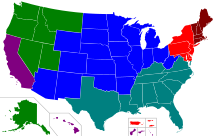
Regional accreditation map
There are seven regional accreditors concerned in larger schooling accreditation in the US.[81]
- Accrediting Fee for Neighborhood and Junior Faculties (previously a part of the Western Affiliation of Colleges and Faculties)
- Larger Studying Fee (HLC) (previously a part of the North Central Affiliation of Faculties and Colleges (NCA))
- Center States Fee on Larger Training
- New England Affiliation of Colleges and Faculties
- (NEASC-CIHE) Fee on Establishments of Larger Training
- (NEASC-CTCI) Fee on Technical and Profession Establishments
- Northwest Fee on Faculties and Universities (NWCCU)
- Southern Affiliation of Faculties and Colleges (SACS) Fee on Faculties
- Accrediting Fee for Colleges, Western Affiliation of Colleges and Faculties (previously a part of the Western Affiliation of Colleges and Faculties)
Moreover, the Board of Regents of the State of New York is acknowledged as an accreditor for degree-granting establishments of upper schooling within the state that designate the company as their sole or major accrediting company.[82] New York is the one state that’s eligible to be federally acknowledged as an accreditor underneath a grandfather clause in federal regulation that permits recognition for state businesses in the event that they have been acknowledged as accreditors earlier than October 1, 1991.[83] By way of a 1984 Constitution with the Board of Regents of the State of New York, the New York State Affiliation of Impartial Colleges supplies accreditation for New York unbiased faculties which can be pre-Okay by way of 12th grade.
Nationwide accreditors[edit]
The nationwide accreditors get their title from their widespread (however not common) apply of accrediting faculties nationwide and even worldwide. Nationwide accreditation has a weaker status than regional accreditation and a few regionally-accredited establishments could not acknowledge switch credit from nationally-accredited establishments. Nevertheless, each regional and nationwide accreditors are topic to the identical recognition standards from the Division of Training.[84][85] Many for-profit (proprietary) faculties are nationally accredited.
- Accrediting Bureau of Well being Training Colleges (ABHES) (acknowledged by USDE[86])
- Accrediting Fee of Profession Colleges and Faculties (ACCSC) (acknowledged by USDE[86])
- Accrediting Council for Persevering with Training and Coaching (ACCET) (acknowledged by USDE[86])
- Accrediting Council for Impartial Faculties and Colleges (ACICS) (acknowledged by USDE[Note 1])
- Distance Training Accrediting Fee (DEAC) (acknowledged by USDE and CHEA[86][90])
- Council on Occupational Training (COE) (acknowledged by USDE[86])
Programmatic accreditation[edit]
These accreditors usually cowl a particular program {of professional} schooling or coaching, however in some instances they cowl the entire establishment. CHEA maintains a listing of acknowledged US programmatic accreditors[91] and the U.S. Division of Training equally maintains a listing of Specialised Accrediting Companies, protecting each programmatic and faith-based accreditors.[92]
- Academy of Vitamin and Dietetics (previously American Dietetic Affiliation Fee on Accreditation for Dietetics Training (CADE-ADA)) (acknowledged by USDE)
- Accreditation Board for Engineering and Know-how (ABET) (acknowledged by CHEA)
- Accreditation Fee for Audiology Training (ACAE) (acknowledged by CHEA)
- Accreditation Fee for Training in Nursing (ACEN) (acknowledged by USDE and CHEA)
- Accreditation Fee for Acupuncture and Oriental Medication (ACAOM) (acknowledged by USDE)
- Accreditation Fee for Midwifery Training (acknowledged by USDE)
- Accreditation Council for Enterprise Colleges and Packages (ACBSP) (acknowledged by CHEA)
- Accreditation Council for Pharmacy Training (ACPE) (acknowledged by USDE and CHEA)
- American Optometric Affiliation (AOA) Accreditation Council on Optometric Training (ACOE) (acknowledged by USDE and CHEA)
- Accreditation Evaluation Fee on Training for the Doctor Assistant (ARC-PA) (acknowledged by CHEA)
- Accrediting Bureau of Well being Training Colleges (acknowledged by USDE)
- Accrediting Council on Training in Journalism and Mass Communications (ACEJMC) (acknowledged by CHEA)
- American Academy of Forensic Sciences (AAFS) Forensic Science Training Packages Accreditation Fee (FEPAC) (acknowledged by CHEA)
- American Affiliation of Household and Client Sciences (AAFCS) Council for Accreditation (CFA) (acknowledged by CHEA)
- American Board of Funeral Service Training (ABFSE) Committee on Accreditation (acknowledged by USDE and CHEA)
- Fee on Accreditation for Marriage and Household Remedy Training, American Affiliation for Marriage and Household Remedy (COAMFTE-AAMFT) (acknowledged by CHEA)
- Council on Accreditation of Nurse Anesthesia Academic Packages (CoA) (acknowledged by USDE and CHEA)
- American Bar Affiliation (ABA) Council of the Part of Authorized Training and Admissions to the Bar (acknowledged by USDE)
- American Council for Development Training (ACCE) (acknowledged by CHEA)
- American Culinary Federation Training Basis Inc. Accrediting Fee (ACFEF-AC) (acknowledged by CHEA)
- American Dental Affiliation (ADA) Fee on Dental Accreditation (acknowledged by USDE)
- Planning Accreditation Board (PAB) (acknowledged by CHEA) (American Institute of Licensed Planners/Affiliation of Collegiate Colleges of Planning)
- American Library Affiliation Committee on Accreditation (ALA-CoA) (acknowledged by CHEA)
- American Occupational Remedy Affiliation Accreditation Council for Occupational Remedy Training (AOTA-ACOTE) (acknowledged by USDE and CHEA)
- American Osteopathic Affiliation Fee on Osteopathic Faculty Accreditation (COCA) (acknowledged by USDE)
- American Bodily Remedy Affiliation Fee on Accreditation in Bodily Remedy Training (APTA-CAPTE) (acknowledged by USDE and CHEA)
- American Podiatric Medical Affiliation Council on Podiatric Medical Training (APMA-CPME) (acknowledged by USDE and CHEA)
- American Psychological Affiliation Committee on Accreditation (APA-CoA) (acknowledged by USDE and CHEA)
- American Society for Microbiology American Faculty of Microbiology (not acknowledged by CHEA or USDE)
- American Society of Train Physiologists (ASEP) (not acknowledged by CHEA or USDE)
- Panorama Architectural Accreditation Board (LAAB) American Society of Panorama Architects (ASLA) (acknowledged by CHEA)
- Council on Tutorial Accreditation in Audiology and Speech-Language Pathology (CAA-ASHA) American Speech-Language-Listening to Affiliation (acknowledged by USDE and CHEA)
- American Veterinary Medical Affiliation (AVMA) Council On Training (COE) (acknowledged by USDE and CHEA)
- Affiliation of Know-how, Administration, and Utilized Engineering (ATMAE) (acknowledged by CHEA)
- Aviation Accreditation Board Worldwide (AABI) (acknowledged by CHEA)
- Affiliation for Scientific Pastoral Training (ACPE) (acknowledged by USDE)
- Affiliation of Establishments of Jewish Research (acknowledged by USDE)
- Fee on Accreditation for Well being Informatics and Data Administration Training (CAHIIM) (acknowledged by CHEA)
- Fee on Accreditation for Respiratory Care (CoARC) (acknowledged by CHEA)
- Fee on Accreditation of Allied Well being Training Packages (CAAHEP) (acknowledged by CHEA)
- Fee on Accreditation of Athletic Coaching Training (CAATE) (acknowledged by CHEA)
- Fee on Accreditation of Healthcare Administration Training (CAHME) (acknowledged by CHEA)
- Fee on Opticianry Accreditation (COA) (acknowledged by CHEA)
- Nationwide Recreation and Park Affiliation (NRPA) Council on Accreditation of Parks, Recreation, Tourism and Associated Professions (COAPRT) (acknowledged by CHEA)
- Fee on Collegiate Nursing Training (CCNE) (acknowledged by USDE)
- Fee on English Language Program Accreditation (CEA) (acknowledged by USDE)
- Fee on Therapeutic massage Remedy Accreditation (acknowledged by USDE)
- Council for the Accreditation of Educator Preparation (CAEP) (acknowledged by CHEA)
- Council for Accreditation of Counseling and Associated Academic Packages (CACREP) (acknowledged by CHEA)
- Council for Inside Design Accreditation (CIDA) (acknowledged by CHEA)
- Council for Requirements in Human Service Training (CSHSE) (acknowledged by CHEA)
- Council on Chiropractic Training (CCE) (acknowledged by USDE and CHEA)
- Council on Training for Public Well being (acknowledged by USDE)
- Council on Naturopathic Medical Training (acknowledged by USDE)
- Council on Rehabilitation Training (CORE) Fee on Requirements and Accreditation (acknowledged by CHEA)
- Council on Social Work Training (CSWE) Council on Accreditation (acknowledged by CHEA)
- Worldwide Meeting for Collegiate Enterprise Training (IACBE) (acknowledged by CHEA)
- Worldwide Fireplace Service Accreditation Congress–Diploma Meeting (IFSAC–DA) (acknowledged by CHEA)
- Joint Evaluation Committee on Training Packages in Radiologic Know-how (JRCERT) (acknowledged by USDE and CHEA)
- Joint Evaluation Committee on Academic Packages in Nuclear Medication Know-how (JRCNMT) (acknowledged by CHEA)
- Panorama Architectural Accreditation Board American Society of Panorama Architects (LAAB-ASLA) (acknowledged by CHEA)
- Liaison Committee on Medical Training (acknowledged by USDE)
- Midwifery Training Accreditation Council (acknowledged by USDE)
- Montessori Accreditation Council for Trainer Training (MACTE) (acknowledged by USDE)
- Nationwide Accrediting Company for Scientific Laboratory Sciences (NAACLS) (acknowledged by CHEA)
- Nationwide Accrediting Fee of Profession Arts and Sciences, Inc. (NACCAS) (acknowledged by USDE)
- Nationwide Architectural Accrediting Board (NAAB) (acknowledged by the Nationwide Council of Architectural Registration Boards and state registration boards[93])
- Nationwide Affiliation of Colleges of Artwork and Design (NASAD) Fee on Accreditation (acknowledged by USDE)
- Nationwide Affiliation of Colleges of Dance (NASD) Fee on Accreditation (acknowledged by USDE)
- Nationwide Affiliation of Colleges of Music (NASM) Fee on Accreditation and Fee on Neighborhood/Junior Faculty Accreditation (acknowledged by USDE)
- Nationwide Affiliation of Colleges of Theatre (NAST) Fee on Accreditation (acknowledged by USDE)
- Nationwide Environmental Well being Science and Safety Accreditation Council (EHAC) (acknowledged by the U.S. Public Well being Service[94])
- Community of Colleges of Public Coverage, Affairs, and Administration (NASPAA) Fee on Peer Evaluation and Accreditation (COPRA) (acknowledged by CHEA)
- Planning Accreditation Board (acknowledged by CHEA)
- Psychological Scientific Science Accreditation System (PCSAS) (acknowledged by CHEA)
- State Bar of California Committee of Bar Examiners[95] (acknowledged by the State of California)
Nationwide faith-based accreditors[edit]
There are 4 acknowledged nationwide faith-based accrediting our bodies in the US, all additionally recognised by the U.S. Division of Training.[81]
- Affiliation of Superior Rabbinical and Talmudic Colleges (AARTS)[92]
- Affiliation of Theological Colleges in the US and Canada (ATS) Fee on Accrediting[92]
- Affiliation for Biblical Larger Training (ABHE) Fee on Accreditation[92]
- Transnational Affiliation of Christian Faculties and Colleges (TRACS) Accreditation Fee[86]
See additionally[edit]
- Worldwide Affiliation of Universities
- Record of unrecognized larger schooling accreditation organizations
- Central and East European Administration Growth Affiliation
Notes[edit]
- ^ Recognition by USDE underneath evaluate as of April 2018 following court docket reversal of December 2016 resolution to take away recognition.[87][88][89]
References[edit]
- ^ “Presentation”. INQAAHE. Retrieved 2 April 2017.
.mw-parser-output cite.quotation{font-style:inherit}.mw-parser-output .quotation q{quotes:”””””””‘””‘”}.mw-parser-output .id-lock-free a,.mw-parser-output .quotation .cs1-lock-free a{background-image:url(“//add.wikimedia.org/wikipedia/commons/thumb/6/65/Lock-green.svg/9px-Lock-green.svg.png”);background-image:linear-gradient(clear,clear),url(“//add.wikimedia.org/wikipedia/commons/6/65/Lock-green.svg”);background-repeat:no-repeat;background-size:9px;background-position:proper .1em middle}.mw-parser-output .id-lock-limited a,.mw-parser-output .id-lock-registration a,.mw-parser-output .quotation .cs1-lock-limited a,.mw-parser-output .quotation .cs1-lock-registration a{background-image:url(“//add.wikimedia.org/wikipedia/commons/thumb/d/d6/Lock-gray-alt-2.svg/9px-Lock-gray-alt-2.svg.png”);background-image:linear-gradient(clear,clear),url(“//add.wikimedia.org/wikipedia/commons/d/d6/Lock-gray-alt-2.svg”);background-repeat:no-repeat;background-size:9px;background-position:proper .1em middle}.mw-parser-output .id-lock-subscription a,.mw-parser-output .quotation .cs1-lock-subscription a{background-image:url(“//add.wikimedia.org/wikipedia/commons/thumb/a/aa/Lock-red-alt-2.svg/9px-Lock-red-alt-2.svg.png”);background-image:linear-gradient(clear,clear),url(“//add.wikimedia.org/wikipedia/commons/a/aa/Lock-red-alt-2.svg”);background-repeat:no-repeat;background-size:9px;background-position:proper .1em middle}.mw-parser-output .cs1-subscription,.mw-parser-output .cs1-registration{colour:#555}.mw-parser-output .cs1-subscription span,.mw-parser-output .cs1-registration span{border-bottom:1px dotted;cursor:assist}.mw-parser-output .cs1-ws-icon a{background-image:url(“//add.wikimedia.org/wikipedia/commons/thumb/4/4c/Wikisource-logo.svg/12px-Wikisource-logo.svg.png”);background-image:linear-gradient(clear,clear),url(“//add.wikimedia.org/wikipedia/commons/4/4c/Wikisource-logo.svg”);background-repeat:no-repeat;background-size:12px;background-position:proper .1em middle}.mw-parser-output code.cs1-code{colour:inherit;background:inherit;border:inherit;padding:inherit}.mw-parser-output .cs1-hidden-error{show:none;font-size:100%}.mw-parser-output .cs1-visible-error{font-size:100%}.mw-parser-output .cs1-maint{show:none;colour:#33aa33;margin-left:0.3em}.mw-parser-output .cs1-subscription,.mw-parser-output .cs1-registration,.mw-parser-output .cs1-format{font-size:95%}.mw-parser-output .cs1-kern-left,.mw-parser-output .cs1-kern-wl-left{padding-left:0.2em}.mw-parser-output .cs1-kern-right,.mw-parser-output .cs1-kern-wl-right{padding-right:0.2em}.mw-parser-output .quotation .mw-selflink{font-weight:inherit} - ^ “Mission”. INQAAHE. Retrieved 2 April 2017.
- ^ a b c “Full Members”. INQAAHE. Retrieved 2 April 2017.
- ^ “CHEA Worldwide Listing”. CHEA. Retrieved 1 April 2017.
- ^ “ENQA | European Affiliation for High quality Assurance in Larger Training”. Enqa.eu. Retrieved 2014-05-07.
- ^ a b c “Members”. ENQA. Retrieved 2 April 2017.
- ^ “ENQA Historical past”. ENQA. Retrieved 2 April 2017.
- ^ “EQAR: House”. Eqar.eu. Retrieved 2014-05-07.
- ^ “Enic-Naric”. Enic-Naric. Retrieved 2015-03-07.
- ^ “FINLEX ® – Ajantasainen lainsäädäntö: 24.7.2009/558”. Finlex.fi. Retrieved 2015-03-07.
- ^ Standing Convention of the Ministries of Training and Cultural Affairs of the Länder within the Federal Republic of Germany, Basis and Composition
- ^ Standing Convention of the Ministries of Training and Cultural Affairs of the Länder within the Federal Republic of Germany, Qualitätssicherung im Hochschulbereich
- ^ Kultusministerkonferenz. Ländergemeinsame Strukturvorgaben gemäß § 9 Abs. 2 HRG für die Akkreditierung von Bachelor- und Masterstudiengängen. October 10, 2003, amended September 18, 2008
- ^ Council of Sciences and Humanities, Perform Archived April 17, 2010, on the Wayback Machine
- ^ Decision of the Standing Convention of the Ministries of Training and Cultural Affairs of the Federal Republic of Germany of December 16, 2004. Settlement on the Basis “Basis: Accreditation of Examine Programs in Germany.” Archived March 13, 2012, on the Wayback Machine
- ^ Accreditation Council, Mission Assertion
- ^ Accreditation Council, Accreditation Companies
- ^ Accreditation Council, Accreditation of Packages
- ^ “ANECA”. Aneca.es. Retrieved 2014-08-24.
- ^ “Training Reform Act 1988, sections 214 to 217”. Opsi.gov.uk. Retrieved 2011-05-24.
- ^ “Test if a college or school is formally recognised: recognised our bodies”. Gov.uk. Retrieved 21 October 2016.
- ^ “Test if a college or school is formally recognised: listed our bodies”. Gov.uk. Retrieved 21 October 2016.
- ^ “About us”. High quality Assurance Company. Retrieved 21 October 2016.
- ^ “Accreditation info desk”. Larger Training Statistics Company. 20 September 2016. Retrieved 21 October 2016.
- ^ “Skilled, Statutory and Regulatory Our bodies (PSRBs) {and professional} accreditation of undergraduate programmes”. Larger Training Statistics Company. 5 Could 2016. Retrieved 21 October 2016.
- ^ “Immigration Guidelines half 3: college students”. UK House Workplace. Three January 2017. A57B(c)(ii). Retrieved 2 April 2017.
- ^ “Associates”. ENQA. Retrieved 2 April 2017.
- ^ “Administration and construction”. British Council. Retrieved 2 April 2017.
- ^ “Accreditation”. British Council. Retrieved 2 April 2017.
- ^ “ABLS Accreditation: The Accreditation Physique for Language Providers”. ABLS. Retrieved 2 April 2017.
- ^ “The Open & Distance Studying High quality Council”. ODLQC. Retrieved 2 April 2017.
- ^ “Hong Kong Council for Accreditation of Tutorial and Vocational {Qualifications}”. Hkcaa.edu.hk. Archived from the unique on 2011-07-21. Retrieved 2011-05-24.
- ^ “Record of Programmes Accredited by the HKCAAVQ”. Hkcaavq.edu.hk. 2007-12-12. Archived from the unique on 2011-07-21. Retrieved 2011-05-24.
- ^ [1] Archived July 21, 2011, on the Wayback Machine
- ^ Press Launch Precautions towards “Faux Universities/Vishwavidyalayas” (PDF), College Grants Fee, December 2011, retrieved 2015-03-07
- ^ “Larger Training in India”. Authorities of India Ministry of Human Useful resource Growth Division of Larger Training. Archived from the unique on 2011-07-18. Retrieved 2011-05-24.
- ^ “The Official Web site of Board of Engineers Malaysia”. Board of Engineers Malaysia (BEM). Retrieved 21 November 2016.
- ^ “Official Portal of Malaysian Medical Council”. Malaysian Medical Council (MMC). Retrieved 21 November 2016.
- ^ “Malaysian Dental Council (MDC) :: Majlis Pergigian Malaysia (MPM)”. Malaysian Dental Council (MDC). Retrieved 21 November 2016.
- ^ “Pharmacy Board | Pharmaceutical Providers Divisions”. Pharmacy Board Malaysia. Retrieved 21 November 2016.
- ^ “Official Portal of Conventional and Complementary Medication Division”. Malaysian Chinese language Medical Associations (MCMA). Retrieved 21 November 2016.
- ^ “首页 | 马来西亚中医师暨针灸联合总会 | FCPAAM”. Federation of Chinese language Physicians and Acupuncturists Associations Malaysia (FCPAAM). Retrieved 21 November 2016.
- ^ “Official Portal of Nursing Division, Ministry of Well being”. Malaysia Nursing Board. Retrieved 21 November 2016.
- ^ “Malaysian Veterinary Council (MVC)”. Malaysian Veterinary Council (MVC). Retrieved 21 November 2016.
- ^ “MPHM – Malaysian Homeopathic Medical Council”. Malaysian Homeopathic Medical Council (MPHM). Retrieved 21 November 2016.
- ^ “Lembaga Arkitek Malaysia”. Lembaga Arkitek Malaysia (LAM). Retrieved 21 November 2016.
- ^ “BQSM – Official Portal of Board of Amount Surveyors Malaysia”. Board of Amount Surveyors Malaysia (BQSM). Retrieved 21 November 2016.
- ^ “Malaysian Bar Council”. Malaysian Bar Council. Retrieved 21 November 2016.
- ^ “Malaysian Institute of Accountants”. Malaysian Institute of Accountants (MIA). Retrieved 21 November 2016.
- ^ “Chartered Tax Institute of Malaysia”. Chartered Tax Institute of Malaysia (CTIM). Retrieved 21 November 2016.
- ^ “FPAM – Monetary Planning Affiliation of Malaysia”. Monetary Planning Affiliation of Malaysia (FPAM). Retrieved 21 November 2016.
- ^ “AICB”. Asian Institute of Chartered Bankers (AICB). Retrieved 21 November 2016.
- ^ “MACS | Malaysian Affiliation of Firm Secretaries | Persatuan Setiausaha Syarikat Malaysia”. Malaysian Affiliation of Firm Secretaries (MACS). Retrieved 21 November 2016.
- ^ “Chartered Secretaries Malaysia (MAICSA)”. The Malaysian Institute of Chartered Secretaries and Directors (MAICSA). Retrieved 21 November 2016.
- ^ “LPPEH – The Board of Valuers, Appraisers and Property Brokers Malaysia”. Board of Valuers, Appraisers & Actual Property Brokers Malaysia (LPPEH). Retrieved 21 November 2016.
- ^ “Welcome to LogM”. The Society of Logisticians, Malaysia. Retrieved 21 November 2016.
- ^ “College Grants Fee”. Ugcnepal.edu.np. Retrieved 2015-03-07.
- ^ “Tutorial Mobility and the Training System of Nepal – WENR”. Wenr.wes.org. 2013-03-01. Retrieved 2015-03-07.
- ^ “Nepal Engineering Council”. Nec.gov.np. Retrieved 2015-03-07.
- ^ “Nepal Nursing Council”. Nnc.org.np. Retrieved 2015-03-07.
- ^ “NMC”. NMC. Retrieved 2015-03-07.
- ^ “Nepal Pharmacy Council”. Nepal Pharmacy Council. 2007-05-10. Retrieved 2015-03-07.
- ^ “Welcome to Nepal Bar Council, Nepal”. Nepal Bar Council. Retrieved 2015-03-07.
- ^ “House”. NZQA. Retrieved 2015-03-07.
- ^ “CNU.::.CONSEJO NACIONAL DE UNIVERSIDADES”. cnu.edu.ni. Retrieved 2014-05-07.
- ^ a b “By Accreditation Councils”. hec.gov.pk.
- ^ “.: Nationwide Accreditation Council :. Index”. nacte.org.pk.
- ^ “Nationwide Agriculture Training Accreditation Council”. naeac.org.
- ^ “You’re being redirected…” www.nbeac.org.pk.
- ^ “Archived copy”. Archived from the unique on 2011-02-13. Retrieved 2011-02-11.CS1 maint: archived copy as title (hyperlink)
- ^ “Nationwide Know-how Council”. www.ntc-hec.org.pk.
- ^ “Pakistan Bar Council”.
- ^ “PCATP Election 2019”. pcatp.org.pk.
- ^ “Pharmacy Council Pakisatn”. www.pharmacycouncil.org.pk.
- ^ “PEC”. www.pec.org.pk.
- ^ “Pakistan Medical & Dental Council”. www.pmdc.org.pk.
- ^ “House”. pnc.org.pk.
- ^ “House”. pvmc.org.pk.
- ^ “Nationwide Council for Homoeopathy, Pakistan”. nchpakistan.gov.pk.
- ^ “Nationwide Council For Tibb -“.
- ^ a b “Acknowledged Accrediting Organizations” (PDF). Council for Larger Training Accreditation. August 2010. Retrieved 2010-10-18.
- ^ “Faculty Accreditation within the United States- Pg 7”. Ed.gov. Retrieved 2015-03-07.
- ^ “Why States Should not Accredit @insidehighered”. Insidehighered.com. Retrieved 2015-03-07.
- ^ Lindsay McKenzie (Eight September 2017). “The Accreditation Race”. Inside Larger Ed.
- ^ “Accreditation Information”. Maryvale College. Retrieved Eight February 2020.
- ^ a b c d e f “Regional and Nationwide Institutional Accrediting Companies”. U.S. Division of Training. Retrieved 31 March 2017.
- ^ “Training Division Establishes Enhanced Federal Help Participation Necessities for ACICS-accredited Faculties” (Press launch). United States Division of Training. December 12, 2016. Archived from the unique on December 26, 2016. Retrieved December 28, 2016.
- ^ Adam Harris (25 March 2018). “Federal Decide Fingers a Victory to Embattled Accreditor”. The Chronicle of Larger Training.
- ^ Betsy DeVos (Training Secretary) (Three April 2018). “Within the matter of Accrediting Council for Impartial Faculties and Colleges” (PDF). USDE.
- ^ Cite error: The named reference CHEA Profession was invoked however by no means outlined (see the assistance web page).
- ^ “Programmatic Accrediting Organizations 2016–2017”. Council for Larger Training Accreditation. Retrieved 31 March 2017.
- ^ a b c d “Specialised Accrediting Companies”. U.S. Division of Training. Retrieved 31 March 2017.
- ^ “How NCARB Differs From Different Organizations”. Nationwide Council of Architectural Registration Boards. Retrieved 1 April 2017.
- ^ “Sources”. Environmental Well being Officer Skilled Advisory Committee. U.S. Public Well being Service. Insurance policies and Requirements. Retrieved 31 March 2017.
- ^ “State Bar of California, CBE, “Title 4. Admissions and Academic Requirements, Division 2. Accredited Regulation Faculty Guidelines””. Calbar.ca.gov. Retrieved 2011-05-24.
Content material retrieved from: https://en.wikipedia.org/wiki/List_of_recognized_higher_education_accreditation_organizations.

