
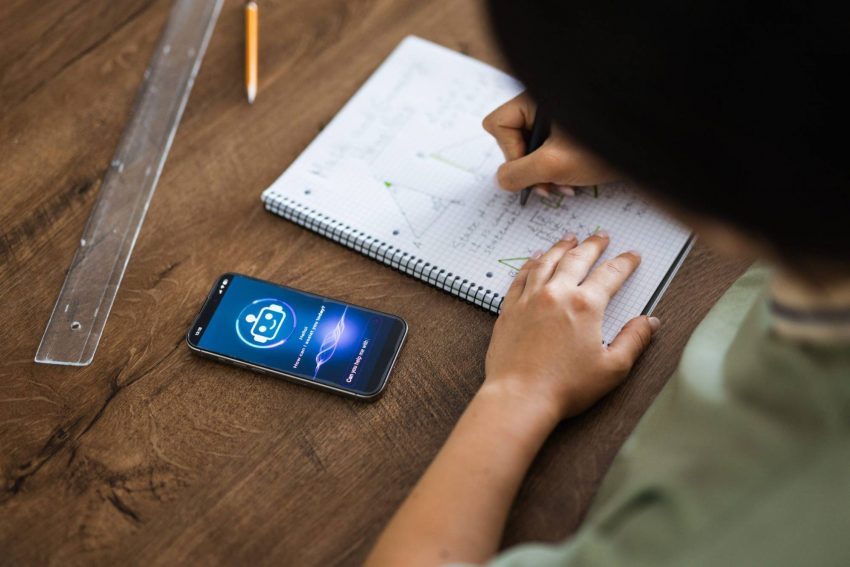
If you need a glimpse into cutting-edge analysis on synthetic intelligence in schooling, look to Jing Liu, director of the Middle for Instructional Knowledge Science and Innovation on the College of Maryland. Two research launched in October provide a putting and enlightening distinction. One hinted that somewhat AI-powered math practice may assist struggling center schoolers enhance their abilities. The opposite discovered that an AI assistant undermined school college students’ engagement and hurt their grades.
Liu wished the research to be launched collectively, he instructed me, to indicate that AI in schooling is neither “all good” nor “all dangerous.” The sector continues to be determining the best way to design instruments that enhance studying over time. And meaning finding out not simply the know-how, but additionally how college students reply to it — together with in methods its creators by no means supposed.
Within the first experiment, a math observe web site referred to as Goblins was rolled out to six,000 center schoolers in Deer Valley, Arizona, through the 2025-26 faculty 12 months. Lecturers assigned issues to their college students. An AI tutor provided step-by-step assist by textual content chatting, drawing on a digital whiteboard and even spoken dialog. Lecturers have been inspired to make use of it with struggling college students, although some assigned it to their total courses and others skipped it altogether.
College students who solved at the least two issues every week — greater than 50 over the college 12 months — scored considerably greater on a year-end standardized evaluation in math than related college students who used Goblins much less or by no means. Speed up, an impartial, nonprofit analysis group that commissioned the research, equated the statistical distinction of 0.11 customary deviations to about three additional months of learning.
However maintain off on the celebratory bot music. The research can’t show that Goblins triggered the positive factors. College students who used it extra may merely have been extra motivated to observe math and may nicely have examined higher in math with or with out Goblins. Speed up hopes to fee a randomized managed trial to settle the matter.
Nonetheless, one consequence from this research is value highlighting: Half the 6,000 college students used Goblins to deal with at the least two issues every week, the dosage related to greater math scores.
That’s noteworthy as a result of schooling know-how is suffering from one thing that schooling researchers name the “five-percent problem.” A device may fit fantastically for college students who use it as directed, however as a rule of thumb, solely about 5 % really do. The opposite 95 % both don’t log in at dwelling or sit idly by the minutes of scheduled screentime in school. Research on Khan Academy, IXL and different platforms have nicely documented this problem of getting youngsters to make use of their tutorial software program persistently.
Goblins appeared to achieve some college students who are sometimes laborious to interact, together with English learners and college students with disabilities. Liu suspects that’s as a result of college students might discuss aloud to a cartoon avatar of their trainer, which might discuss again. Furthermore, the AI tutor might communicate and perceive Spanish and 6 different languages.
“It was like speaking to your individual trainer,” mentioned Liu. “It made the scholars need to use it.”
Lecturers’ management over assignments might have helped, too. Slightly than surrendering the lesson to a pc, lecturers determined which issues to assign to which college students and had the choice to add their very own issues. That echoes analysis findings from older schooling know-how. One other center faculty math platform, ASSISTments, additionally produced strong results utilizing comparatively small quantities of teacher-assigned observe with instantaneous suggestions for college students.
Nonetheless, I don’t need to overstate how partaking or interesting Goblins was. Solely 6 % of the scholars on this experiment used it for at the least half an hour every week, which is a extra frequent dosage advice in ed tech and for which Goblins’ utilization mirrors the acquainted five-percent downside.
When AI entry backfires
Liu’s different experiment examined an AI assistant developed on the College of Maryland. Earlier than deploying it throughout the college to all 40,000 college students, Provost Jennifer King Rice requested Liu to check it first.
In the course of the fall semester of 2025, Liu randomly assigned 15 of 30 professors so as to add the AI assistant to their courses. The opposite 15 taught the identical programs, with out AI. Topics ranged from English and math to biology and social sciences. For instance, two professors taught separate sections of the identical biology course, one with the AI assistant and one with out.
Professors supplied the university’s AI chatbot with syllabuses, readings, assignments and different course supplies. In the course of the semester, college students might ask about task directions and deadlines or get assist understanding ideas. The assistant was accessible across the clock by Canvas, the college’s on-line studying administration system.
By the top of the 12 months, the 1,100 college students in programs with the AI assistant had decrease grades — decreased by a mean of 0.11 factors on a four-point scale, roughly the distinction between a 3.0 (a strong B) and a 2.9 (a low B) – in contrast with the 1,200 college students within the management group. In addition they interacted much less with course supplies (comparable to making a touch upon the category’s on-line dialogue board) and have been much less more likely to attend workplace hours or meet with instructors and friends. The detrimental results have been extra pronounced for first-generation college students.
“AI instruments might exacerbate inequities in studying outcomes,” Rice instructed a University of Maryland publication. “That’s significantly troubling to me.”
Solely 15 % of scholars within the AI-enhanced courses ever used the assistant. Those that did principally requested it for solutions reasonably than benefiting from its tutoring options.
How might a device utilized by so few college students have such detrimental results?
Liu and Rice suspect that the AI assistant’s fixed presence within the course web site despatched an unintended message: AI use is inspired. College students might have taken that as permission to make use of ChatGPT, Claude or Gemini exterior the college’s platform to finish assignments. The researchers can’t set up whether or not that occurred. But when AI did the work for college students, it might have left them learning less.
The lesson isn’t that faculties ought to keep away from AI, says Liu. It’s that even a rigorously designed device can have penalties past its supposed use. And Maryland deserves credit score for testing the assistant earlier than a university-wide rollout and for making the troubling outcomes public for the entire area to study from.
This story about AI tutor research was produced by The Hechinger Report, a nonprofit, impartial information group that covers schooling. Join Proof Points and different Hechinger newsletters.